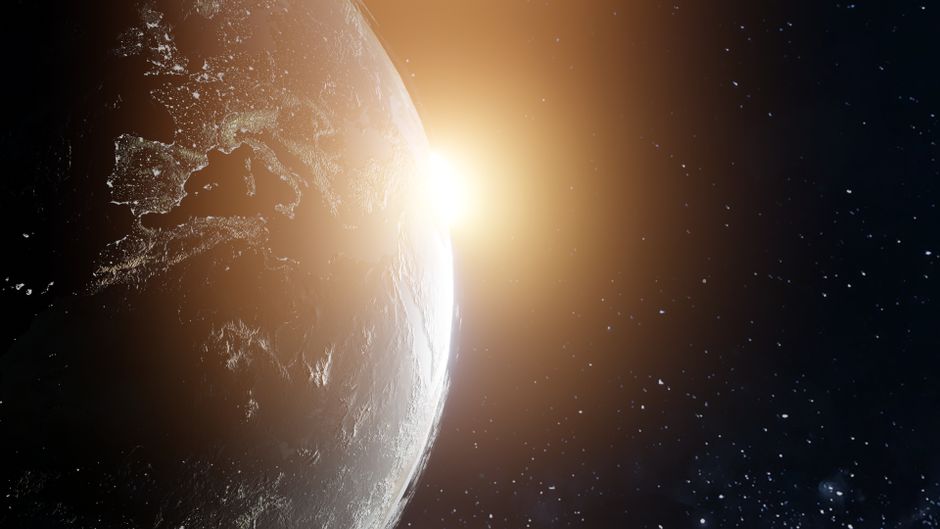
Our Planet Gets a Cosmic Reprieve
Have you ever lain awake at night worrying about the sun eventually consuming our planet? Well, you can finally sleep soundly. Recent astronomical research brings surprisingly optimistic news: Earth might actually dodge being swallowed by our dying star, defying centuries of assumptions about our world’s ultimate fate.
For generations, scientists have operated under a rather grim assumption. When the sun exhausts its hydrogen fuel in roughly five billion years, it will balloon into a red giant, expanding dramatically and engulfing everything in its path—or so we thought. Mercury, Venus, and Earth were all presumed to be cosmic toast. But new gravitational models are painting a different picture entirely, and it’s far more hopeful than anyone expected.
Understanding the Sun’s Future Transformation
Our sun, like all stars, follows a predictable lifecycle. For the past 4.6 billion years, it has steadily converted hydrogen into helium through nuclear fusion in its core. This process has kept the sun remarkably stable, providing the energy that makes life on Earth possible. However, all good things eventually come to an end.
When the hydrogen in the sun’s core becomes depleted, the star will enter a new phase. The core will contract while the outer layers expand dramatically, transforming our sun into a red giant. During this phase, the sun’s radius could extend nearly to Earth’s current orbital position. This is where the conventional wisdom predicted our planet’s demise. But the plot thickens.
The Surprising Role of Stellar Winds
The key to Earth’s potential survival lies in something often overlooked: the sun’s stellar winds. As the sun evolves into a red giant, it will shed enormous amounts of mass—up to half of its current mass—through powerful solar winds streaming outward into space. This mass loss is no trivial matter for planetary mechanics.
As the sun loses mass, its gravitational grip on Earth weakens considerably. Think of it like a spinning figure skater extending their arms: the system changes in fundamental ways. With less mass pulling on our planet, Earth’s orbit would gradually drift outward, potentially carrying it safely beyond the sun’s bloated outer layers. Rather than being incinerated, our world might slip away to a cooler, more distant orbit.
Did you know? The sun loses roughly one million tons of material every second through solar wind, and this process will intensify dramatically during its red giant phase.
What This Means for Earth’s Long-Term Future
This doesn’t mean Earth will be a pleasant place to visit during the sun’s twilight years. The surface temperatures would be far too extreme for current life forms to survive. The atmosphere would be stripped away, oceans would evaporate, and any remaining water would freeze on the outer reaches of a new orbital zone. Yet the planet itself—the rocky sphere we call home—would persist.
In a cosmic sense, this is genuinely good news. While humanity will certainly need to confront its relationship with Earth’s climate long before the sun becomes unstable, knowing that our home planet might survive the sun’s death throes provides a measure of comfort. It suggests that the universe isn’t entirely hostile to persistence and continuity.
The Big Picture
Five billion years is incomprehensibly far in the future. Civilizations rise and fall on timescales of thousands of years. Species evolve and vanish in millions of years. By the time the sun becomes a concern for planetary survival, Earth’s story may have transformed beyond our wildest imagination. Yet understanding these cosmic timescales helps us appreciate the extraordinary gift of the stable, predictable star that has nurtured life for billions of years.
What do you find more remarkable: that we might have solved the mystery of Earth’s distant fate, or that we live in an era where such cosmic questions are even answerable?